


Page 30 - ACTIVE SCIENCE 4 TOC
P. 30
A daptations in Animals

            Every organism undergoes a change over a period of time to adapt to its surroundings.
            Animals too change. The characterstics which make an organism to adjust and survive
            in its surroundings is called adaptation. The animals adapt to their environment
            for their survival. Let us study about different animals and their adaptations.


            Adaptations to Environment
            The different natural surroundings where different animals live are called its
            habitat. On the basis of different habitats, animals are categorised as terrestrial,
            aerial, aquatic and arboreal.


            Terrestrial Animals

            The animals that live on land in different climatic
            conditions are called terrestrial animals. Horses,
            camels, bears, foxes, humans are examples of such
            animals.
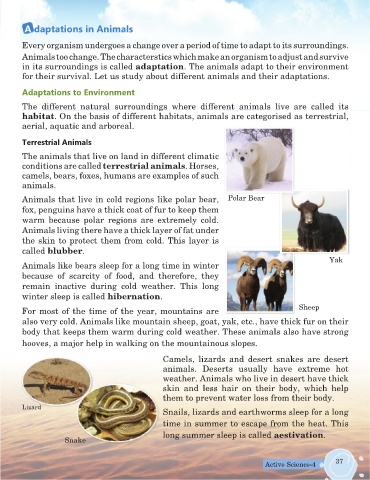
            Animals that live in cold regions like polar bear,                   Polar Bear

            fox, penguins have a thick coat of fur to keep them
            warm because polar regions are extremely cold.
            Animals living there have a thick layer of fat under
            the skin to protect them from cold. This layer is
            called blubber.
                                                                                                                  Yak
            Animals like bears sleep for a long time in winter
            because of scarcity of food, and therefore, they
            remain inactive during cold weather. This long
            winter sleep is called hibernation.


            For most of the time of the year, mountains are                                             Sheep
            also very cold. Animals like mountain sheep, goat, yak, etc., have thick fur on their
            body that keeps them warm during cold weather. These animals also have strong
            hooves, a major help in walking on the mountainous slopes.


                                                           Camels, lizards and desert snakes are desert
                                                           animals. Deserts usually have extreme hot
                                                           weather. Animals who live in desert have thick
                                                           skin and less hair on their body, which help
                                                           them to prevent water loss from their body.
            Lizard
                                                           Snails, lizards and earthworms sleep for a long
                                                           time in summer to escape from the heat. This
                                                           long summer sleep is called aestivation.
                          Snake


                                                                                                                    37
                                                                                             Active Science-4

