


Page 100 - ACTIVE SCIENCE 4 TOC
P. 100
down by the  action of micro-organisms

            present in soil. This produces a fertile layer
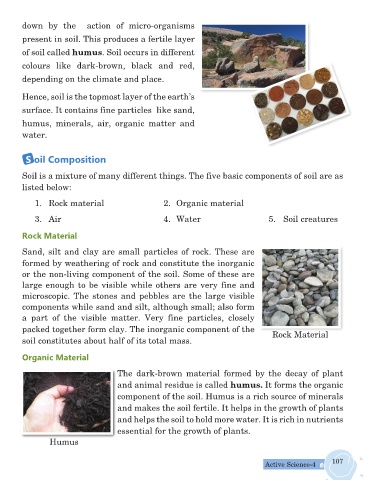
            of soil called humus. Soil occurs in different

            colours like dark-brown, black and red,

            depending on the climate and place.

            Hence, soil is the topmost layer of the earth’s

            surface. It contains fine particles  like sand,

            humus, minerals, air, organic  matter and
            water.


              S oil Composition

            Soil is a mixture of many different things. The five basic components of soil are as
            listed below:

                 1.  Rock material                         2.  Organic material


                 3.  Air                                   4.  Water                           5.  Soil creatures

            Rock Material

            Sand, silt and clay are small particles of rock. These are

            formed by weathering of rock and constitute the inorganic
            or the non-living component of the soil. Some of these are
            large enough to be visible while others are very fine and
            microscopic. The stones and pebbles are the large visible

            components while sand and silt, although small; also form
            a part of the visible matter. Very fine particles, closely
            packed together form clay. The inorganic component of the                          Rock Material

            soil constitutes about half of its total mass.


            Organic Material
                                            The dark-brown material formed by the decay of plant

                                            and animal residue is called humus. It forms the organic
                                            component of the soil. Humus is a rich source of minerals

                                            and makes the soil fertile. It helps in the growth of plants
                                            and helps the soil to hold more water. It is rich in nutrients
                                            essential for the growth of plants.
                     Humus


                                                                                                                   107
                                                                                             Active Science-4

