


Page 22 - ACTIVE SCIENCE 4 TOC
P. 22
A nimals That Lay Eggs

            Animals that lay eggs are called oviparous animals. The parent animals sit on
            the eggs to keep them warm. This is known as incubation. Frog, fish, snake,

            lizard and insects like cockroach and butterfly are examples of animals which
            reproduce by laying eggs.


            Birds

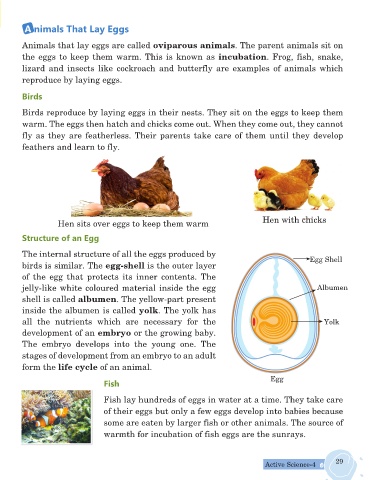
            Birds reproduce by laying eggs in their nests. They sit on the eggs to keep them
            warm. The eggs then hatch and chicks come out. When they come out, they cannot
            fly as they are featherless. Their parents take care of them until they develop

            feathers and learn to fly.


                        Hen sits over eggs to keep them warm                                Hen with chicks

            Structure of an Egg

            The internal structure of all the eggs produced by
            birds is similar. The egg-shell is the outer layer                                              Egg Shell
            of the egg that protects its inner contents. The

            jelly-like white coloured material inside the egg                                                 Albumen
            shell is called albumen. The yellow-part present
            inside the albumen is called yolk. The yolk has

            all the nutrients which are necessary for the                                                       Yolk
            development of an embryo or the growing baby.
            The embryo develops into the young one. The

            stages of development from an embryo to an adult
            form the life cycle of an animal.

                                                                                               Egg
                                       Fish

                                       Fish lay hundreds of eggs in water at a time. They take care
                                       of their eggs but only a few eggs develop into babies because

                                       some are eaten by larger fish or other animals. The source of
                                       warmth for incubation of fish eggs are the sunrays.


                                                                                                                    29
                                                                                             Active Science-4

