


Page 16 - ACTIVE SCIENCE 4 TOC
P. 16
These plants have a unique way to capture their prey – the trap is a bladder
                  that creates a vacuum that sucks in insects.

                  1.  The Pitcher Plant is a pitcher-shaped plant. A sticky substance is secreted

                      from its edges which makes the insect sitting on it slip inside the pitcher
                      hence, getting trapped.

                  2.  The Venus Flytrap has two lobes which have spikes on their edges. As soon
                      as an insect sits on it, the lobes shut, thus entrapping the insect.

                  3.  A Bladderwort vacuums its prey into a special bag where it is digested.

                      The bag even has a seal that snaps shut once the prey is inside. The trap
                      usually secretes sugars that lure insects.


            Activity 2.2

            Find out about the plant life existing in very cold places like Arctic zones.


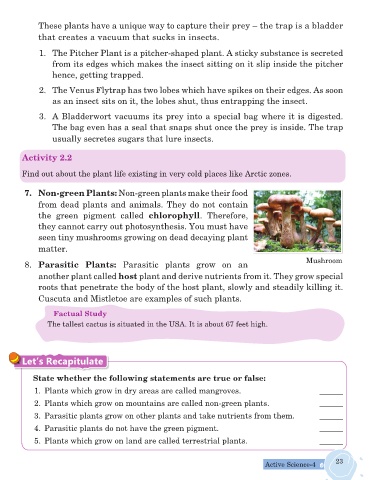
             7.  Non-green Plants: Non-green plants make their food

                  from dead plants and animals. They do not contain
                  the green pigment called  chlorophyll. Therefore,
                  they cannot carry out photosynthesis. You must have
                  seen tiny mushrooms growing on dead decaying plant

                  matter.

             8.  Parasitic Plants:  Parasitic plants grow on an                                           Mushroom
                  another plant called host plant and derive nutrients from it. They grow special

                  roots that penetrate the body of the host plant, slowly and steadily killing it.
                  Cuscuta and Mistletoe are examples of such plants.

                       Factual Study
                     The tallest cactus is situated in the USA. It is about 67 feet high.


            Let’s Recapitulate


                State whether the following statements are true or false:
                1.  Plants which grow in dry areas are called mangroves.                                       ______

                2.  Plants which grow on mountains are called non-green plants.                                ______
                3.  Parasitic plants grow on other plants and take nutrients from them.                        ______

                4.  Parasitic plants do not have the green pigment.                                            ______
                5.  Plants which grow on land are called terrestrial plants.                                   ______


                                                                                                                    23
                                                                                             Active Science-4

