


Page 114 - ACTIVE SCIENCE 4 TOC
P. 114
4.  The process by which solid changes into liquid is called _____________.
                     a.  melting                                         b. freezing

                     c.  evaporation                                     d. condensation

                B. Fill in the blanks.

                1.  The process by which a liquid changes into a solid on cooling is called _____________.
                2.  The process by which a liquid changes into gaseous form on heating is called
                    _____________.

                3.  The process by which gas changes into a liquid on cooling is called _____________.

                4.  The solid which dissolves in the liquid is called _____________.
                5.  _____________ have no fixed shape but have fixed volume.

                6.  Matter exists in _____________ states.
                7.  The liquid obtained after dissolving a solute in a solvent is called _____________.

                8.  The particles cannot move _____________ in solids.

                C. State whether the following statements are true or false:

                1.  Solids cannot flow.                                                                        ______
                2.  Liquids do not have fixed volume.                                                          ______

                3.  Gases can flow in all directions.                                                          ______

                4.  The particles are not packed closely to each other in solids.                              ______

                D. Short Answer Questions:

                1.  What is matter?
                2.  What is a solid?

                3.  How does a solute dissolve in a solvent?

                4.  What is condensation?
                5.  What is freezing?

                6.  Write any three properties of gas.

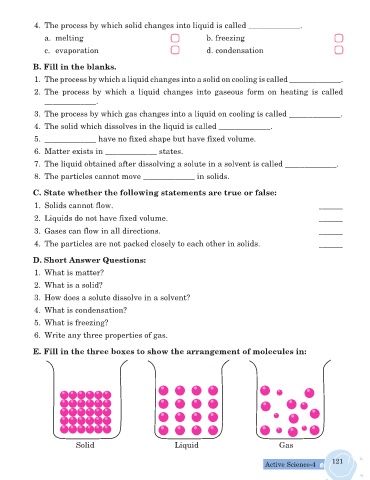
                E. Fill in the three boxes to show the arrangement of molecules in:


                              Solid                            Liquid                            Gas


                                                                                                                   121
                                                                                             Active Science-4

