


Page 111 - ACTIVE SCIENCE 4 TOC
P. 111
C hanging States Of Matter

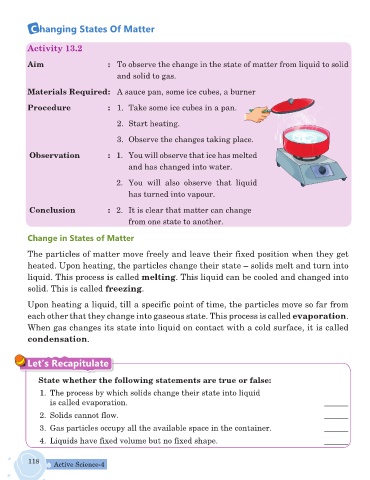
              Activity 13.2


              Aim                       :  To observe the change in the state of matter from liquid to solid
                                            and solid to gas.

              Materials Required :  A sauce pan, some ice cubes, a burner


              Procedure                  :  1.  Take some ice cubes in a pan.

                                         2.  Start heating.

                                          3.  Observe the changes taking place.


               Observation              :   1.  You will observe that ice has melted
                                                and has changed into water.

                                          2.  You will also observe that liquid

                                                has turned into vapour.

               Conclusion               :  2.  It is clear that matter can change
                                                from one state to another.


              Change in States of Matter

              The particles of matter move freely and leave their fixed position when they get
              heated. Upon heating, the particles change their state – solids melt and turn into
              liquid. This process is called melting. This liquid can be cooled and changed into

              solid. This is called freezing.

              Upon heating a liquid, till a specific point of time, the particles move so far from

              each other that they change into gaseous state. This process is called evaporation.
              When gas changes its state into liquid on contact with a cold surface, it is called
              condensation.


              Let’s Recapitulate

                  State whether the following statements are true or false:
                  1.  The process by which solids change their state into liquid
                      is called evaporation.                                                                    ______

                  2.  Solids cannot flow.                                                                       ______

                  3.  Gas particles occupy all the available space in the container.                            ______
                  4.  Liquids have fixed volume but no fixed shape.                                             ______


              118      Active Science-4

