


Page 78 - ACTIVE SCIENCE 4 TOC
P. 78
droplets on its outside. The water vapour in the atmosphere comes in contact with
            the cool glass and condenses to form water droplets.

            Likewise, fog is a thick layer of clouds made of tiny drops of water. Dew can be

            seen in the early morning during winters in the form of tiny drops of water on
            grass and leaves. Frost is seen when water freezes into tiny white crystals. Hail

            is formed when the freezing raindrops pass through a very cold region. Snow is
            formed when water vapour freezes into white snowflakes.


            Activity 9.1

            Aim                       :  Observing evaporation and condensation.

            Materials Required :  A cotton cloth, a glass of cold juice.


            Procedure                  :  1.  Wash a handkerchief and keep it out under sunlight.

                                        2.  Also fill a glass of cold juice and keep it aside.

                                        3.  Observe both the things after an hour.

            Observation               :   You will find that the cloth has dried up. You will also find tiny

                                          droplets of water on the outer surface of the glass.

            Conclusion                :   The water in the cloth has evaporated due to the heat of the sun.
                                          In case of the glass, the water vapour present in the air condensed

                                          on the outer surface of the glass and so, tiny water droplets were seen.


             Water Cycle

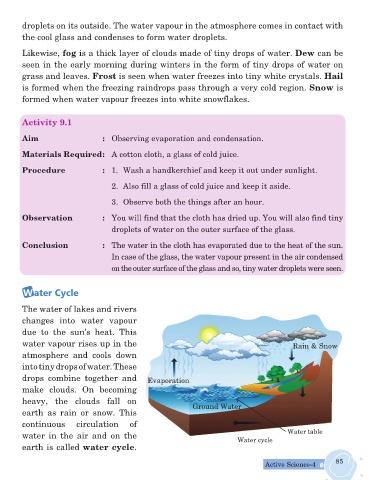
            The water of lakes and rivers

            changes into water vapour
            due to the sun’s heat. This
            water vapour rises up in the                                                              Rain & Snow

            atmosphere and cools  down
            into tiny drops of water. These
            drops combine together and                Evaporation

            make clouds. On becoming
            heavy, the clouds fall on                                Ground Water
            earth as rain or snow. This

            continuous        circulation       of
            water  in  the air and on the                                           Water cycle     Water table

            earth is called water cycle.

                                                                                                                    85
                                                                                             Active Science-4

