


Page 76 - ACTIVE SCIENCE 4 TOC
P. 76
The Sun Causes Winds To Blow

                                                     The heat of the sun affects the wind’s movement.
                                                     The air heats up because of the sun’s heat and so,

                                                     air gets lighter. The warmer and lighter air rises to
                                                     flow.In turn, the heavier cool air comes in to take

                                                     its place. This results in the continuous movement
                                                     of air causing winds.


            How Are Clouds Formed?

            The sun’s heat changes the water into water vapour. The amount of water vapour
            present in the atmosphere is called humidity. As the water vapour rises high up
            in the sky, it cools down and condenses into tiny droplets of water. As a result,
            these droplets combine and form clouds. When these clouds get too heavy and can

            no longer hold the water, they fall as rain on the earth. Therefore, the sun plays a
            crucial role in changing the states of water.


             A ir

            Air is very important for all living things to breath. We can feel the air but we
            cannot see it. It is made up of different gases and contains water vapour, dust
            particles and smoke. Simple moving air is called wind. Wind which is gentle is

            called breeze. Strong and fast air is called gale. Very fast and strong wind can
            cause storms.

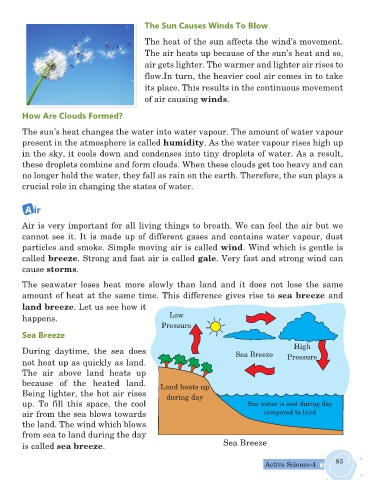
            The seawater loses heat more slowly than land and it does not lose the same
            amount of heat at the same time. This difference gives rise to sea breeze and

            land breeze. Let us see how it
            happens.                                         Low
                                                           Pressure
            Sea Breeze

            During daytime, the sea does                                           Sea Breeze         High
            not heat up as quickly as land.                                                         Pressure
            The air above land heats up
            because of the heated land.                   Land heats up
            Being lighter, the hot air rises                during day

            up. To fill this space, the cool                                           Sea water is cool during day
            air from the sea blows towards                                                  compared to land
            the land. The wind which blows
            from sea to land during the day
            is called sea breeze.                                              Sea Breeze


                                                                                                                    83
                                                                                             Active Science-4

