


Page 60 - ACTIVE SCIENCE 4 TOC
P. 60
The food or bolus then goes into the stomach through the food pipe. The food pipe
            contracts and relaxes so as to push the food down into the stomach. The stomach

            is a muscular bag where food stays for many hours. It produces digestive juices
            and acid which help to digest the food.

            The remaining undigested food is pushed into a long coiled tube called the small

            intestine. The small intestine, along with the liver and pancreas produces a juice
            that mixes with the food and digests it. The walls of the intestine absorb all the
            nutrients from the digested food. Then the blood vessels which carry digested food

            absorb these nutrients and transport them to all parts of the body.

            Undigested food passes into the  large intestine  where the extra water and
            minerals are absorbed. The  rectum stores the remaining solid waste until it

            passes out through the anus.

            Activity 7.1


            Find out why your stomach produces a rumbling sound in between meals.


            Let’s Recapitulate

                Fill in the blanks.

                1.  The process of breaking down of food into a simpler form is called _____________.

                2.  _____________ is a digestive liquid secreted by the salivary glands.
                3.  The undigested food pushed into a long tube is called _____________.

                4.  The extra water is absorbed by _____________.
                5.  The food stays in the stomach for _____________.


             M icrobes

            We cannot see microbes with naked eyes. Microbes can only be seen through a
            microscope because they are very tiny in size. They can grow anywhere – on or
            inside our body, on soil, food, stagnant water, etc. Microbes which cause diseases

            are called germs or pathogens.

            There are four kinds of microbes.


            Bacteria

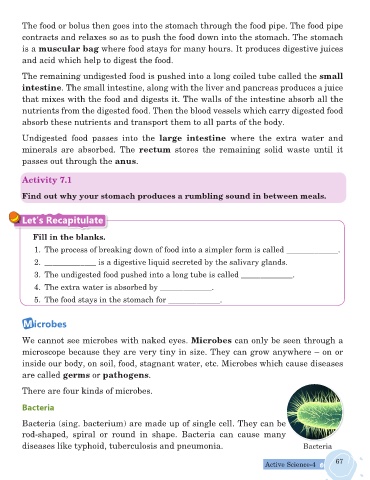
            Bacteria (sing. bacterium) are made up of single cell. They can be
            rod-shaped, spiral or round in shape. Bacteria can cause many
            diseases like typhoid, tuberculosis and pneumonia.                                           Bacteria


                                                                                                                    67
                                                                                             Active Science-4

