


Page 58 - ACTIVE SCIENCE 4 TOC
P. 58
Gum


                    Molars
                                                           Incisors         Canines        Premolars          Molars


                 Premolars
                Canine
                   Incisors
                             Permanent Teeth
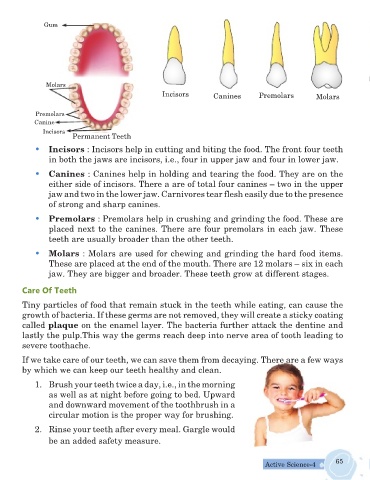
                 •  Incisors : Incisors help in cutting and biting the food. The front four teeth
                     in both the jaws are incisors, i.e., four in upper jaw and four in lower jaw.

                 •  Canines : Canines help in holding and tearing the food. They are on the
                     either side of incisors. There a are of total four canines – two in the upper

                     jaw and two in the lower jaw. Carnivores tear flesh easily due to the presence
                     of strong and sharp canines.
                 •  Premolars : Premolars help in crushing and grinding the food. These are

                     placed next to the canines. There are four premolars in each jaw. These
                     teeth are usually broader than the other teeth.

                 •  Molars : Molars are used for chewing and grinding the hard food items.
                     These are placed at the end of the mouth. There are 12 molars – six in each
                     jaw. They are bigger and broader. These teeth grow at different stages.


            Care Of Teeth
            Tiny particles of food that remain stuck in the teeth while eating, can cause the
            growth of bacteria. If these germs are not removed, they will create a sticky coating
            called plaque on the enamel layer. The bacteria further attack the dentine and
            lastly the pulp.This way the germs reach deep into nerve area of tooth leading to

            severe toothache.

            If we take care of our teeth, we can save them from decaying. There are a few ways
            by which we can keep our teeth healthy and clean.

                 1.  Brush your teeth twice a day, i.e., in the morning
                     as well as at night before going to bed. Upward
                     and downward movement of the toothbrush in a
                     circular motion is the proper way for brushing.

                 2.  Rinse your teeth after every meal. Gargle would
                     be an added safety measure.


                                                                                                                    65
                                                                                             Active Science-4

