


Page 87 - ACTIVE SCIENCE 4 TOC
P. 87
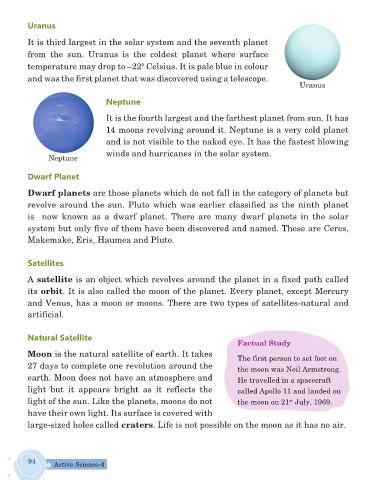
Uranus

              It is third largest in the solar system and the seventh planet

              from the sun. Uranus is  the  coldest planet  where surface
              temperature may drop to –22  Celsius. It is pale blue in colour
                                                    0
              and was the first planet that was discovered using a telescope.
                                                                                                        Uranus


                                        Neptune

                                        It is the fourth largest and the farthest planet from sun. It has
                                        14 moons revolving around it. Neptune is a very cold planet

                                        and is not visible to the naked eye. It has the fastest blowing
                                        winds and hurricanes in the solar system.
                     Neptune


              Dwarf Planet

              Dwarf planets are those planets which do not fall in the category of planets but

              revolve around the sun. Pluto which was earlier classified as the ninth planet
              is  now known as a dwarf planet. There are many dwarf planets in the solar
              system but only five of them have been discovered and named. These are Ceres,

              Makemake, Eris, Haumea and Pluto.


              Satellites

              A satellite is an object which revolves around the planet in a fixed path called

              its orbit. It is also called the moon of the planet. Every planet, except Mercury
              and Venus, has a moon or moons. There are two types of satellites-natural and
              artificial.


              Natural Satellite
                                                                                    Factual Study
              Moon is the natural satellite of earth. It takes                      The first person to set foot on

              27 days to complete one revolution around the                         the moon was Neil Armstrong.
              earth. Moon does not have an atmosphere and                           He travelled in a spacecraft

              light but it appears bright as it reflects the                        called Apollo 11 and landed on
              light of the sun. Like the planets, moons do not                      the moon on 21  July, 1969.
                                                                                                     st
              have their own light. Its surface is covered with
              large-sized holes called craters. Life is not possible on the moon as it has no air.


              94       Active Science-4

